The Complete Guide to RFID in Healthcare
Everything you need to know about RFID technology in healthcare: how it works, key applications from patient identification to surgical instrument tracking, compliance requirements, ROI data, and a step-by-step implementation roadmap for hospitals and clinics.

What Is RFID and Why Does Healthcare Need It?
Radio Frequency Identification (RFID) is a wireless technology that uses electromagnetic fields to automatically identify and track tags attached to objects, people, or assets. Each RFID tag contains a microchip and an antenna. When a tag enters the field of an RFID reader, it transmits its stored data wirelessly — no line of sight, no manual scanning, no human intervention required.
In healthcare, this seemingly simple technology solves a problem that has plagued hospitals for decades: the inability to know, in real time, where everything and everyone is. Patients, medications, surgical instruments, infusion pumps, wheelchairs, blood products, specimens — the modern hospital is a vast, moving ecosystem of assets and people that must be tracked with precision to prevent errors and save lives.
The global RFID in healthcare market was valued at $6.9 billion in 2024 and is projected to grow at a compound annual growth rate (CAGR) of 14.6% through 2030. This growth is driven by mounting regulatory pressure, patient safety imperatives, and the hard financial reality that hospitals lose millions annually to inefficiency, equipment loss, and preventable errors.
This guide covers everything a healthcare administrator, IT director, or clinical leader needs to understand about RFID: how the technology works, where it delivers the greatest value, what it costs, what compliance frameworks apply, and how to implement it successfully.
How RFID Works in a Hospital Environment
An RFID system in a hospital consists of four core components:
**RFID Tags:** Small devices containing a microchip and antenna, attached to patients (wristbands), staff (badges), equipment, medications, or surgical instruments. Tags can be passive (powered by the reader's signal), active (battery-powered with greater range), or semi-passive (battery-assisted but activated by the reader).
**RFID Readers:** Fixed or handheld devices that emit radio waves and receive data from tags. Fixed readers are installed at doorways, in storage rooms, and throughout corridors. Handheld readers allow nurses and technicians to scan items at the point of care.
**Middleware:** Software that filters, aggregates, and routes the raw data from readers to hospital information systems. Middleware handles event processing, data deduplication, and business rules — for example, triggering an alert when a tagged infant approaches an exit.
**Integration Layer:** The connection between RFID middleware and existing hospital systems including Electronic Health Records (EHR), Computerized Physician Order Entry (CPOE), pharmacy systems, and enterprise resource planning (ERP) platforms.
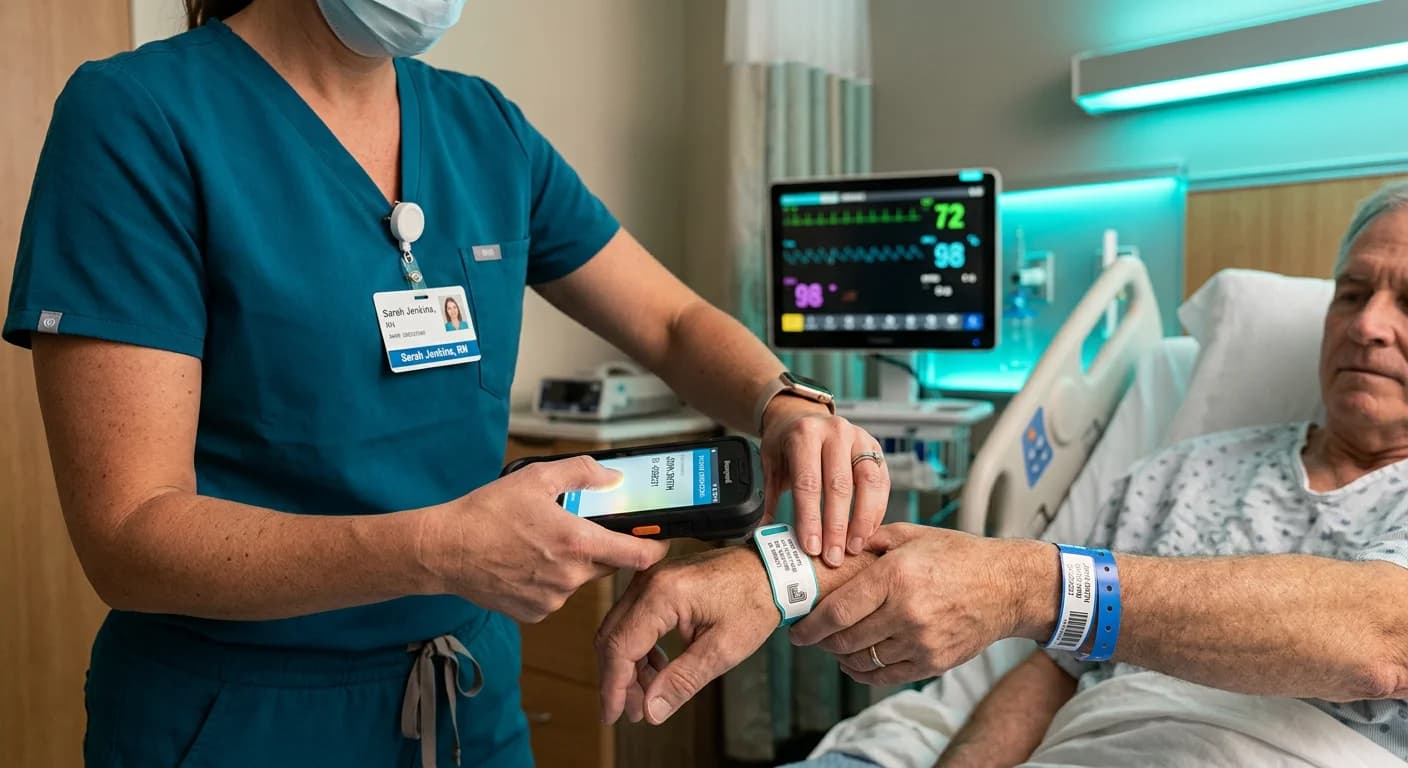
When a nurse wearing an RFID badge approaches a medication cabinet, the reader identifies the nurse, verifies access permissions, and logs the interaction. When she scans the patient's RFID wristband at the bedside, the system cross-references the medication against the prescription in the EHR. Every step is automated, timestamped, and auditable.
Key Applications of RFID in Healthcare
Patient Identification and Safety
Misidentification remains one of the most dangerous and persistent problems in healthcare. The Joint Commission has listed patient identification as a National Patient Safety Goal every year since 2003. RFID wristbands provide a reliable, automated solution.
Unlike printed barcodes that can smudge, fade, or be applied to the wrong patient, RFID wristbands encode unique patient identifiers that are read automatically and cross-referenced against hospital records. The wristband does not need to be visible or positioned correctly — it simply needs to be within range of a reader.
Hospitals using RFID patient identification report near-elimination of wrong-patient procedures and a significant reduction in identification-related adverse events.
Asset Tracking and Equipment Management
Nurses spend an average of 30 minutes per shift searching for equipment. Across a hospital with 1,000 nursing staff, this translates to 500 hours of lost clinical time every single day. Meanwhile, studies indicate that 10-20% of a hospital's mobile assets are lost, misplaced, or stolen at any given time.
RFID-based Real-Time Location Systems (RTLS) solve this by providing continuous visibility into the location and status of every tagged asset. Infusion pumps, wheelchairs, portable monitors, sequential compression devices — each is tagged and tracked on a digital floor plan accessible from any workstation or mobile device.
The financial impact is substantial. Hospitals deploying RFID asset tracking report a 60% reduction in lost equipment, an 80% decrease in search time, and average ROI of 300-400% over three years.
Medication Management
Medication errors affect over 7 million patients annually in the United States, costing the healthcare system an estimated $40 billion per year. RFID addresses this at multiple points in the medication chain.
Smart medication cabinets equipped with RFID readers verify that the nurse accessing the cabinet is authorized, that the medication being retrieved matches the patient's prescription, and that the five rights of medication administration are satisfied: right patient, right drug, right dose, right route, and right time.
Facilities implementing RFID medication management have documented an 86% reduction in medication administration errors, a 45% decrease in medication reconciliation time, and annual savings exceeding $2 million in prevented adverse events.
Surgical Instrument Tracking
Retained surgical instruments are a serious patient safety concern, occurring in an estimated 1 in 5,500 surgical procedures. Each incident carries an average cost of $200,000 in additional treatment and liability. Beyond retained instruments, manual counting is time-consuming, error-prone, and delays operating room turnover.
RFID-tagged surgical instruments are scanned automatically as they enter and leave the sterile field. The system maintains a real-time count and alerts the surgical team immediately if an instrument is unaccounted for at closure. Hospitals using RFID instrument tracking report near-elimination of retained instrument events and a 15-20% improvement in OR turnover time.
Additionally, RFID enables complete lifecycle tracking of surgical instruments — from sterilization through use and reprocessing — ensuring compliance with manufacturer guidelines and accreditation requirements.
Blood Bank and Transfusion Safety
Blood transfusion errors remain one of the most consequential failures in clinical medicine. RFID technology provides end-to-end traceability from the moment blood is collected from a donor to the point of transfusion at the patient's bedside.
RFID-enabled blood bags are tagged at collection with data including blood type, collection date, expiration date, and donor identification. Readers in blood bank refrigerators monitor inventory and temperature conditions continuously. At the bedside, the nurse scans both the patient's RFID wristband and the blood bag tag, and the system verifies compatibility before authorizing the transfusion.
The RFID blood monitoring systems market is projected to reach $3.5 billion by 2033, with facilities reporting 100% donor-to-patient traceability and a 20% reduction in blood product waste.
Infant Security
Infant abduction, though rare, is a catastrophic event that every hospital must guard against. RFID-based infant security systems attach a tag to the newborn's ankle or umbilical cord clamp. If the infant is carried beyond a defined perimeter — typically the maternity ward boundaries — the system locks down exits, triggers alarms, and alerts security personnel instantly.
Modern systems also match infant tags with mother tags, ensuring that the correct baby is always with the correct mother and preventing accidental switching.
RFID vs Barcode: Why Healthcare Is Moving Beyond Barcodes
Barcodes have served healthcare well, but their limitations become critical in high-acuity, fast-paced environments:
**Line of sight:** Barcodes require direct optical scanning. The barcode must be visible, clean, and properly oriented. RFID reads through packaging, clothing, and containers without line of sight.
**One at a time:** A barcode scanner reads one item at a time. An RFID reader can capture 100 or more tags simultaneously, enabling bulk inventory counts in seconds rather than hours.
**Durability:** Printed barcodes degrade when exposed to moisture, chemicals, heat, or abrasion — all common in hospital environments. RFID tags withstand sterilization, refrigeration, and repeated handling.
**Data capacity:** A standard barcode holds roughly 20-25 characters. An RFID tag can store kilobytes of data and can be rewritten thousands of times.
**Automation:** Barcode scanning requires a human to physically aim and trigger the scanner. RFID can operate passively and continuously, detecting tagged items as they move through spaces without human action.
The tradeoff is cost. A printed barcode label costs fractions of a cent; a passive RFID tag costs $0.10-$0.50, and active tags can cost $5-$50. However, the labor savings, error reduction, and operational improvements delivered by RFID produce a compelling return on investment that barcodes simply cannot match.
RFID Frequency Types: LF, HF, and UHF Explained
RFID systems operate at three primary frequency bands, each suited to different healthcare applications:
Low Frequency (LF): 125-134 kHz
LF RFID has a short read range (typically under 10 cm) and slow data transfer rates. It performs well near liquids and metals, making it suitable for animal tracking and some access control applications. In healthcare, LF is used primarily in proximity access cards for door entry and some legacy patient wristband systems.
High Frequency (HF): 13.56 MHz
HF RFID, including the widely adopted NFC (Near Field Communication) standard, operates at a read range of up to one meter. It offers good performance near liquids and human tissue, making it the dominant frequency for patient wristbands, medication verification, and blood bag tracking. The ISO 15693 and ISO 14443 standards govern most HF healthcare applications.
Ultra-High Frequency (UHF): 860-960 MHz
UHF RFID provides the longest read range (up to 12 meters for passive tags) and the highest data throughput. It is the preferred technology for asset tracking, surgical instrument management, and supply chain applications where many tags must be read simultaneously at a distance. UHF performance can be affected by liquids and metals, but modern tag designs have largely mitigated these issues.
Most modern hospital deployments use a combination of frequencies: HF for patient-facing applications (wristbands, medication verification) and UHF for asset tracking and supply chain management.
EHR Integration: Making RFID Data Actionable
RFID technology generates enormous volumes of location and identification data. Without integration into clinical workflows, this data is noise. The value of RFID is realized when it connects seamlessly with the hospital's Electronic Health Record system.
**Automated clinical documentation:** When a nurse scans a patient's RFID wristband during medication administration, the event is logged directly in the EHR, eliminating manual charting and ensuring accuracy.
**Real-time patient flow:** RFID data feeds into bed management and patient flow dashboards, giving administrators real-time visibility into admissions, discharges, transfers, and bottlenecks.
**Equipment-patient association:** When an infusion pump is brought to a patient's room, the RFID system can automatically associate that pump with the patient record, enabling usage tracking and billing accuracy.
**Alert integration:** RFID-triggered alerts (medication mismatches, wandering patients, missing instruments) appear within the EHR or nurse call system rather than in a separate application, reducing alert fatigue and ensuring clinical staff see critical notifications in context.
Major EHR platforms including Epic, Cerner (now Oracle Health), and MEDITECH offer RFID integration capabilities, typically through HL7 or FHIR interfaces. Successful integration requires close collaboration between RFID vendors, EHR analysts, and clinical informaticists.
Compliance and Regulatory Landscape
HIPAA (Health Insurance Portability and Accountability Act)
RFID systems that capture, store, or transmit Protected Health Information (PHI) must comply with HIPAA Security and Privacy Rules. Key considerations include:
FDA (Food and Drug Administration)
The FDA regulates medical devices and pharmaceutical supply chain integrity. RFID tags used on medical devices must comply with FDA Unique Device Identification (UDI) requirements. The Drug Supply Chain Security Act (DSCSA) mandates electronic tracking of pharmaceutical products, where RFID plays an increasingly central role.
The Joint Commission
The Joint Commission's accreditation standards directly intersect with RFID capabilities in several areas: patient identification (NPSG.01.01.01), medication management, surgical safety (Universal Protocol), and infection prevention. RFID systems provide the automated documentation and traceability that Joint Commission surveyors look for during accreditation reviews.
GDPR and International Regulations
For healthcare organizations operating in the European Union or handling EU patient data, RFID systems must comply with the General Data Protection Regulation (GDPR). This includes data minimization, purpose limitation, consent management, and the right to erasure.
ROI: The Financial Case for RFID in Healthcare
The return on investment for RFID in healthcare is well-documented across multiple application areas:
**Asset tracking ROI:** Hospitals report average savings of $500-$1,500 per bed annually from reduced equipment loss, lower rental costs, and improved utilization. A 500-bed hospital typically saves $750,000-$1,000,000 per year, with implementation costs recovered within 12-18 months.
**Medication safety ROI:** The average cost of a preventable adverse drug event is $8,750. A 300-bed hospital experiencing 100 preventable ADEs annually saves $875,000 per year from RFID medication verification systems, before accounting for reduced litigation exposure.
**Surgical instrument ROI:** Automated instrument tracking saves 15-20 minutes per surgical case in count time. For a hospital performing 10,000 cases per year, this translates to 2,500-3,300 hours of recovered OR time, valued at $1,500-$2,000 per hour.
**Labor efficiency ROI:** By eliminating time spent searching for equipment, verifying identities manually, and performing manual inventory counts, hospitals report labor savings equivalent to 2-5 FTEs, depending on facility size.
**Risk mitigation ROI:** Reduced litigation from retained instruments, medication errors, and patient misidentification events represents significant but harder-to-quantify savings that often dwarf the direct operational benefits.
Implementation: A Step-by-Step Roadmap
Phase 1: Assessment and Planning (6-8 Weeks)
**Needs analysis:** Identify the highest-impact use cases for your facility. Asset tracking and patient identification typically deliver the fastest ROI. Medication management and surgical instrument tracking follow.
**Infrastructure assessment:** Evaluate existing network capacity, physical layout, and potential sources of RF interference (metal structures, medical equipment, building materials).
**Vendor evaluation:** Assess RFID vendors based on healthcare-specific experience, EHR integration capabilities, tag portfolio, and references from comparable facilities.
**Budget and business case:** Develop a detailed financial model including hardware (tags, readers, antennas), software (middleware, analytics), integration, training, and ongoing operational costs.
Phase 2: Pilot Deployment (8-12 Weeks)
**Select pilot scope:** Choose 2-3 departments representing different use cases. A common approach is asset tracking in the ED, medication verification in a medical-surgical unit, and patient identification in radiology.
**Install infrastructure:** Deploy readers, antennas, and network infrastructure in pilot areas. Validate coverage maps and read accuracy.
**Tag and test:** Attach tags to assets, wristbands to patients, and begin testing workflows. Verify integration with EHR and other clinical systems.
**Measure baseline metrics:** Capture pre-implementation data on search times, error rates, inventory accuracy, and staff satisfaction for comparison.
Phase 3: Evaluation and Optimization (4-6 Weeks)
**Analyze pilot results:** Compare post-implementation metrics against baseline. Identify workflow adjustments, reader placement refinements, and integration gaps.
**Staff feedback:** Gather frontline input on usability, alert frequency, and workflow impact. Clinical adoption is the single greatest determinant of RFID success.
**Refine deployment plan:** Update the full-deployment plan based on pilot learnings, including adjusted timelines, additional infrastructure needs, and revised training protocols.
Phase 4: Full-Scale Deployment (3-6 Months)
**Phased rollout:** Expand department by department, prioritizing areas with the highest clinical or financial impact.
**Training:** Conduct role-specific training for nurses, technicians, pharmacists, sterile processing staff, and IT support teams.
**Go-live support:** Station vendor and IT support in each department during the first week of deployment to address issues immediately.
**Continuous optimization:** Establish an RFID governance committee that meets monthly to review system performance, address clinical workflow concerns, and plan feature expansions.
The Future of RFID in Healthcare
The convergence of RFID with artificial intelligence, Internet of Things (IoT) sensors, and cloud analytics is creating a new generation of intelligent hospital systems. AI algorithms analyze RFID-generated data to predict equipment failures before they occur, optimize asset distribution across departments, and identify patterns in patient movement that correlate with fall risk or clinical deterioration.
Temperature-sensing RFID tags now monitor cold chain integrity for pharmaceuticals and blood products in real time. Implantable RFID chips are being explored for long-term patient identification in chronic care populations.
As tag costs continue to decline and read accuracy approaches 100%, RFID is transitioning from a competitive advantage to essential hospital infrastructure — as fundamental as the EHR itself. The question is no longer whether to implement RFID, but how aggressively to pursue it.
Ready to Implement RFID in Your Facility?
Contact us to learn how our RFID solutions can improve patient safety and operational efficiency.
Related Articles

AI-Powered RFID Patient Tracking: The Future of Hospital Safety in 2026
Discover how artificial intelligence combined with RFID technology is revolutionizing patient safety, reducing falls, and preventing wandering incidents in healthcare facilities.
NFC Patient Wristbands: The Future of Bedside Verification
How NFC-enabled wristbands are transforming bedside verification in hospitals, offering tap-to-verify workflows that work through gloves and moisture while integrating seamlessly with smartphones and EHR systems.