NFC Patient Wristbands: The Future of Bedside Verification
How NFC-enabled wristbands are transforming bedside verification in hospitals, offering tap-to-verify workflows that work through gloves and moisture while integrating seamlessly with smartphones and EHR systems.
Understanding NFC in the Healthcare Context
Near Field Communication is a subset of High Frequency RFID technology, operating at 13.56 MHz — the same frequency band used by contactless payment cards, transit passes, and modern smartphones. What distinguishes NFC from broader RFID implementations is its deliberately short communication range, typically 1 to 10 centimeters, and its native compatibility with the billions of NFC-enabled smartphones and tablets already in circulation worldwide.
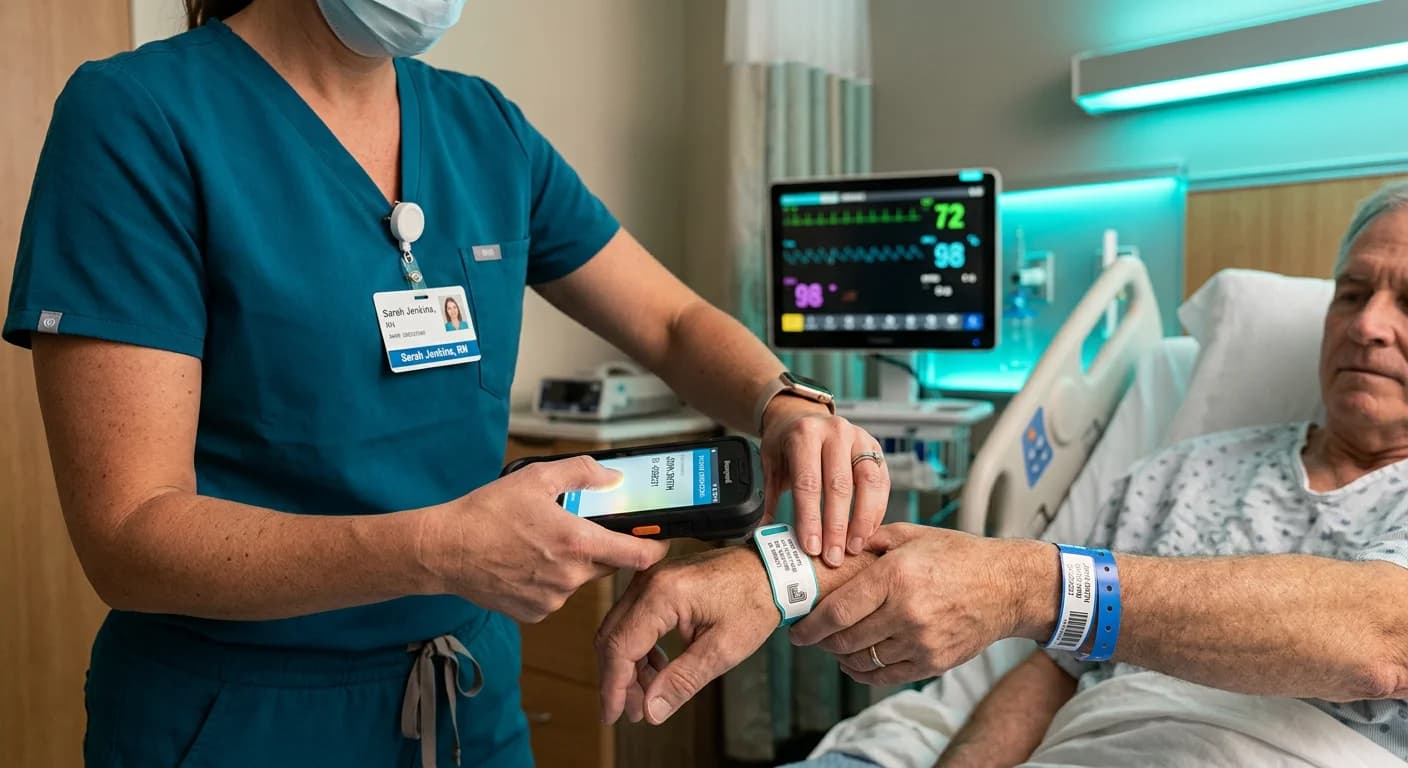
For healthcare, this short range is not a limitation but a design advantage. Bedside verification — confirming the identity of a patient before administering medication, collecting specimens, or performing procedures — requires intentional, point-of-care interaction. A nurse must be physically present at the bedside, making a deliberate tap against the patient's wristband. This intentionality eliminates the accidental reads and ambient interference that can complicate longer-range RFID deployments, while the tap gesture itself serves as a natural confirmation step in clinical workflows.
The global NFC in healthcare market reflects growing recognition of these advantages. Valued at approximately $4.1 billion in 2024, the market is projected to reach $18.3 billion by 2033, driven by hospital digitalization initiatives, smartphone proliferation among clinical staff, and increasing regulatory pressure for verified patient identification at every point of care.
The Tap-to-Verify Workflow at Bedside
NFC patient identification transforms the bedside verification process from a multi-step scanning procedure into a single, intuitive gesture.
**Patient Admission and Banding:** At admission, the patient receives an NFC wristband encoded with a unique patient identifier that links to their record in the Electronic Health Record system. The encoding process takes seconds using a desktop NFC writer or a smartphone with an NFC writing application. The wristband's embedded chip — typically an NXP NTAG213, NTAG215, or NTAG216 — stores the patient identifier in a secure, read-only format that cannot be altered after encoding.
**Bedside Identification:** When a nurse arrives at the bedside to administer medication, collect a specimen, or perform a procedure, they simply tap their NFC-enabled smartphone or tablet against the patient's wristband. The device reads the patient identifier in under one second and automatically retrieves the patient's record, medication orders, allergy alerts, and relevant clinical information from the EHR.
**Verification and Documentation:** The system displays a confirmation screen showing the patient's name, photo (if available), date of birth, and the specific task to be performed. The nurse verifies the information, completes the task, and the system automatically timestamps the interaction and logs it to the patient record. No manual data entry, no barcode alignment, no scanner hardware to carry or charge.
**Closed-Loop Verification:** For high-risk procedures such as blood transfusion or chemotherapy administration, the NFC workflow extends to the product or medication itself. The nurse taps the patient's wristband, then taps the NFC tag on the blood bag or medication package. The system cross-references both identifiers to confirm compatibility before authorizing administration, creating a fully closed-loop verification chain.
Why NFC Outperforms Barcodes at the Bedside
Barcode scanning has been the dominant patient identification technology in hospitals for over two decades, but its limitations at the point of care are well documented. NFC addresses each of these limitations through fundamental differences in how the technologies communicate.
**No Line of Sight Required:** Barcodes require a clear, unobstructed optical path between the scanner and the printed code. In clinical practice, wristband barcodes frequently become obscured by blood, fluids, tape, or skin folds, requiring nurses to reposition the patient's arm, clean the wristband, or manually enter the patient identifier — each workaround introducing delay and error risk. NFC communicates via radio frequency and reads through any non-metallic material, including moisture, bandages, and clinical debris on the wristband surface.
**Works Through Gloves:** Clinical staff wear examination gloves during the majority of patient interactions. Barcode scanners require the user to grip, aim, and trigger the device, which can be cumbersome with gloved hands. NFC tapping is a single, glove-compatible gesture that requires no fine motor manipulation. Capacitive touchscreens on smartphones may not register gloved fingertips, but the NFC tap itself does not require screen interaction.
**Reads Through Moisture:** Operating rooms, wound care, and emergency settings involve wet environments where barcode print quality degrades rapidly. Thermal-printed barcodes smudge, ink fades, and adhesive labels peel in the presence of fluids. NFC chips embedded within the wristband are sealed and waterproof, maintaining consistent readability regardless of environmental conditions throughout the patient's stay.
**No Battery or Charging:** Handheld barcode scanners require regular charging, and dead batteries during a shift create workflow interruptions. NFC wristband tags are passive — they draw power from the NFC reader's electromagnetic field during each tap and require no battery. The reader device is the nurse's own smartphone or a hospital-issued tablet, which is already carried and maintained as part of the clinical workflow.
**Durability Over Multi-Day Stays:** Hospital barcode wristbands frequently need replacement during extended stays as print quality degrades from showering, friction, and normal wear. NFC wristbands maintain perfect readability for the duration of the stay because the identifier is stored digitally in the embedded chip, not printed on the surface.
NFC Wristband Construction and Materials
Medical-grade NFC wristbands are engineered specifically for the healthcare environment, balancing chip performance, patient comfort, and infection control requirements.
**Band Material:** Most medical NFC wristbands use soft, flexible PVC or silicone enclosures that conform comfortably to the wrist. The material is latex-free, hypoallergenic, and compatible with hospital-grade disinfectants including alcohol-based solutions and quaternary ammonium compounds. Some manufacturers offer antimicrobial-treated bands that inhibit bacterial growth on the wristband surface.
**Embedded Chip:** The NFC chip — most commonly the NXP NTAG213 (144 bytes user memory) or NTAG216 (888 bytes user memory) — is laminated within the band material, fully sealed against moisture and physical damage. These chips comply with the ISO 14443 Type A standard and are compatible with all NFC-enabled smartphones (both Android and iOS).
**Thermal Printable Surface:** The wristband includes a thermal-printable area for human-readable patient information — name, date of birth, medical record number, and barcode (as a fallback identification method). This dual-identification approach ensures that patient identity can be verified even if the NFC reader is unavailable, maintaining backward compatibility with barcode-based workflows.
**Closure Mechanism:** Medical wristbands use tamper-evident snap closures that indicate if the band has been removed. Some closures are single-use adhesive; others use snap buttons that are difficult to open without tools. The closure must balance security (preventing unauthorized removal) with clinical practicality (allowing quick removal in emergencies).
**Size Options:** Wristbands are available in adult, pediatric, and neonatal sizes, with adjustable length to accommodate variation in wrist circumference. Neonatal bands may be designed for ankle application instead of wrist wear.
Integration with Smartphones and Tablets
One of NFC's most compelling advantages in healthcare is its native integration with devices that clinical staff already carry.
**Smartphone as Reader:** Every modern smartphone — iPhone (since iPhone 7) and Android devices (since Android 4.0) — includes an NFC reader. This means hospitals can deploy NFC patient identification without purchasing dedicated scanning hardware. Nurses use their existing work smartphones, with a clinical application that activates the phone's NFC reader and connects to the EHR.
**Tablet-Based Workflows:** For facilities that use shared tablets on medication carts or at nursing stations, NFC readers can be integrated into tablet cases or connected via USB. This configuration supports both the NFC tap for patient identification and the tablet's touchscreen for medication verification and documentation.
**BYOD and MDM Compatibility:** Hospitals using Bring Your Own Device policies can deploy NFC clinical applications that are managed through Mobile Device Management platforms. The NFC application accesses the EHR through secure APIs without storing patient data locally on the device, maintaining HIPAA compliance while leveraging personal smartphones.
**Offline Capability:** Advanced NFC clinical applications cache essential patient data locally (in encrypted format) to support bedside verification even when Wi-Fi connectivity is temporarily unavailable. When connectivity is restored, cached interaction logs synchronize automatically with the EHR.
NFC Use Cases Beyond Basic Identification
While patient identification is the foundational use case, NFC wristbands enable a growing range of clinical applications that extend the value of the technology across the care continuum.
**Medication Verification:** The nurse taps the patient's wristband, then taps the NFC tag affixed to the medication package. The system verifies that the medication matches the active order for that patient, checks for allergy conflicts and drug interactions, and confirms the dose and administration route. This five-rights verification occurs in under three seconds.
**Specimen Collection:** Before drawing blood or collecting other specimens, the nurse taps the patient's wristband to generate a specimen label linked to the patient's record. The label is printed at the bedside, eliminating mislabeling errors that occur when specimens are labeled at the nursing station away from the patient.
**Blood Transfusion Verification:** Blood transfusion represents the highest-risk identification scenario in hospital care. NFC enables a three-point verification: tap the patient wristband, tap the blood product tag, and confirm the match on screen. This closed-loop process prevents the ABO-incompatible transfusions that account for the majority of fatal transfusion errors.
**Patient Meal Verification:** For patients on restricted diets — diabetic, renal, allergen-free, or texture-modified — NFC wristbands can be scanned by dietary staff at meal delivery to verify that the correct diet tray is being delivered to the correct patient. This seemingly simple check prevents dietary errors that can have serious clinical consequences for vulnerable patients.
**Procedure and Consent Verification:** Before invasive procedures, NFC verification confirms patient identity and links to the electronic consent documentation, ensuring that the correct procedure is performed on the correct patient with documented authorization.
NFC vs. Traditional RFID for Healthcare Applications
Healthcare facilities evaluating identification technologies must understand the distinct strengths and appropriate applications of NFC versus other RFID frequencies.
**NFC (13.56 MHz, HF RFID):** Short range (1-10 cm), intentional tap required, smartphone-compatible, ideal for bedside verification, medication administration, and any workflow requiring deliberate point-of-care identification. Lower infrastructure cost because smartphones serve as readers.
**UHF RFID (860-960 MHz):** Long range (up to 12 meters), supports bulk reading of multiple tags simultaneously, ideal for asset tracking, supply chain management, and inventory counting. Requires dedicated reader hardware. Not suitable for bedside verification due to the risk of reading the wrong patient's tag from a distance.
**Active RFID (various frequencies):** Battery-powered tags with ranges of 30-100 meters, used for real-time location systems, infant security, and wandering patient management. Higher tag cost and requires battery replacement. Inappropriate for bedside identification due to continuous broadcasting.
For most hospitals, the optimal strategy is a multi-frequency approach: NFC wristbands for bedside verification and medication administration, UHF RFID for asset and supply chain tracking, and active RFID for real-time location and security applications. These technologies are complementary, not competing.
EHR Integration via NFC Readers
The clinical value of NFC patient identification depends entirely on seamless integration with the hospital's Electronic Health Record system.
**HL7 FHIR Integration:** Modern NFC clinical applications communicate with EHR platforms through HL7 FHIR (Fast Healthcare Interoperability Resources) APIs, the emerging standard for healthcare data exchange. When a nurse taps a patient's wristband, the application sends a FHIR Patient.read request to the EHR, retrieving the patient's active medication orders, allergies, recent lab results, and care plan in real time.
**Epic and Cerner Compatibility:** The two dominant EHR platforms in the US market — Epic and Oracle Health (formerly Cerner) — both support NFC-based patient identification through their mobile clinical platforms (Epic Rover and Oracle Health mobile applications). Hospitals running these EHR systems can enable NFC identification with minimal custom development.
**Workflow Engine Integration:** Beyond simple patient lookup, NFC taps can trigger workflow events in the EHR — automatically opening the medication administration record, pre-populating specimen collection forms, or launching the bedside procedure checklist. This context-aware integration reduces the number of screen taps and manual navigation steps required at the bedside.
**Audit Trail and Compliance:** Every NFC interaction is logged with a timestamp, the identity of the clinician (from their device authentication), the patient identifier, and the action performed. This granular audit trail satisfies Joint Commission requirements for patient identification verification and provides forensic-quality documentation for incident investigation.
Cost-Effectiveness Analysis
NFC patient identification delivers compelling cost-effectiveness when compared to traditional barcode-based systems.
**Hardware Savings:** Eliminating dedicated barcode scanners saves $300 to $800 per scanner unit. For a 500-bed hospital with scanners at every bedside, nursing station, and medication cart, this represents $150,000 to $400,000 in hardware cost avoidance over a five-year lifecycle.
**Wristband Costs:** NFC wristbands cost $0.50 to $2.00 per unit depending on chip type and order volume, compared to $0.15 to $0.40 for basic barcode wristbands. The incremental cost of $0.35 to $1.60 per patient admission is offset by reduced reprint rates (NFC wristbands rarely need replacement during a stay, while barcode bands are reprinted in 15-20% of admissions due to degradation).
**Error Reduction Value:** Studies indicate that NFC identification reduces patient identification errors by 60-80% compared to barcode systems. Each prevented wrong-patient error avoids an estimated $10,000 to $50,000 in additional care costs, investigation time, and potential liability.
**Workflow Efficiency:** Nurses using NFC identification report saving 15-30 seconds per identification event compared to barcode scanning. Across an average of 50 identification events per nurse per shift, this translates to 12-25 minutes of recovered nursing time per shift — time that is redirected to direct patient care.
**Total Cost of Ownership:** When hardware savings, reduced wristband replacement, error avoidance, and nursing efficiency gains are combined, NFC patient identification typically delivers a positive ROI within the first year of deployment for facilities with 200 or more beds.
The Shift Toward NFC-First Hospital Strategies
A growing number of hospitals and health systems are adopting NFC-first strategies for patient identification, driven by the convergence of several trends.
**Smartphone Ubiquity:** As hospitals increasingly deploy smartphones to clinical staff for communication, documentation, and clinical reference, the marginal cost of adding NFC identification to these devices is effectively zero — the hardware is already in the nurse's pocket.
**Patient Engagement:** NFC wristbands can serve dual purposes: clinical identification for staff and patient engagement for the wearer. Patients can tap their own wristband against NFC-enabled kiosks to check in for procedures, access their care schedule, view educational materials about their condition, or provide satisfaction survey responses.
**Post-Discharge Applications:** Some health systems are exploring NFC wristbands that patients retain after discharge, enabling tap-to-verify identification at follow-up appointments, pharmacy pickups, and rehabilitation sessions. This continuity of identification across care settings reduces duplicate record creation and improves care coordination.
**Environmental Sustainability:** NFC wristbands generate less waste than barcode systems that require frequent reprinting. As hospitals pursue sustainability goals, the durability of NFC identification aligns with broader institutional priorities.
**Next-Generation Features:** Emerging NFC wristband designs are incorporating additional sensors — temperature monitoring, pulse oximetry, and motion detection — that transform the identification band into a continuous monitoring platform. These multi-function wristbands reduce the number of separate devices attached to the patient while providing both identification and clinical data through a single wearable.
The transition from barcode-first to NFC-first patient identification represents a fundamental shift in how hospitals approach bedside verification. As smartphone-native workflows become the norm and EHR platforms deepen their NFC integration, the tap-to-verify paradigm is positioned to become the standard of care for patient identification in the coming decade.
Ready to Implement RFID in Your Facility?
Contact us to learn how our RFID solutions can improve patient safety and operational efficiency.
Related Articles
AI-Powered RFID Patient Tracking: The Future of Hospital Safety in 2026
Discover how artificial intelligence combined with RFID technology is revolutionizing patient safety, reducing falls, and preventing wandering incidents in healthcare facilities.
The Complete Guide to RFID in Healthcare
Everything you need to know about RFID technology in healthcare: how it works, key applications from patient identification to surgical instrument tracking, compliance requirements, ROI data, and a step-by-step implementation roadmap for hospitals and clinics.