RFID vs Barcode in Healthcare: Which Is Better?
A detailed comparison of RFID and barcode technology in healthcare settings, covering read speed, data capacity, durability, cost, and the best use cases for each — plus why the smartest hospitals use both.

The Identification Technology Dilemma
Every hospital relies on automatic identification technology to track patients, medications, equipment, and supplies. For the past three decades, barcodes have been the workhorse. They are cheap, familiar, and deeply embedded in healthcare workflows from pharmacy dispensing to patient wristbands.
But barcodes were designed for retail checkout lines, not operating rooms. As hospitals pursue higher patient safety standards, tighter regulatory compliance, and leaner operations, the limitations of barcode technology are becoming impossible to ignore. RFID — Radio Frequency Identification — offers capabilities that barcodes simply cannot match.
This does not mean barcodes are obsolete. The smartest healthcare organizations understand that RFID and barcodes are complementary technologies, each best suited to specific applications. This guide provides a comprehensive comparison to help you determine where each technology delivers the greatest value.
How Each Technology Works
Barcode Technology
A barcode encodes data in a pattern of parallel lines (1D barcode) or a grid of squares (2D barcode, such as a QR code). A scanner emits light and reads the reflected pattern, decoding it into alphanumeric data. The scanner must have a clear, direct line of sight to the barcode. The barcode itself is printed on paper, plastic, or adhesive labels.
RFID Technology
An RFID system uses radio waves to communicate between a tag (attached to an object) and a reader. The tag contains a microchip that stores data and an antenna that transmits it. Passive tags are powered by the reader's radio signal; active tags have their own battery. No line of sight is required — RFID signals pass through clothing, packaging, walls, and containers.
Head-to-Head Comparison
Line-of-Sight Requirement
**Barcode:** Requires direct optical line of sight. The scanner must be aimed at the barcode, which must be clean, undamaged, and properly oriented. In clinical settings, this means nurses must physically manipulate wristbands, turn medication packages, and expose labels — consuming time and introducing friction into every workflow.
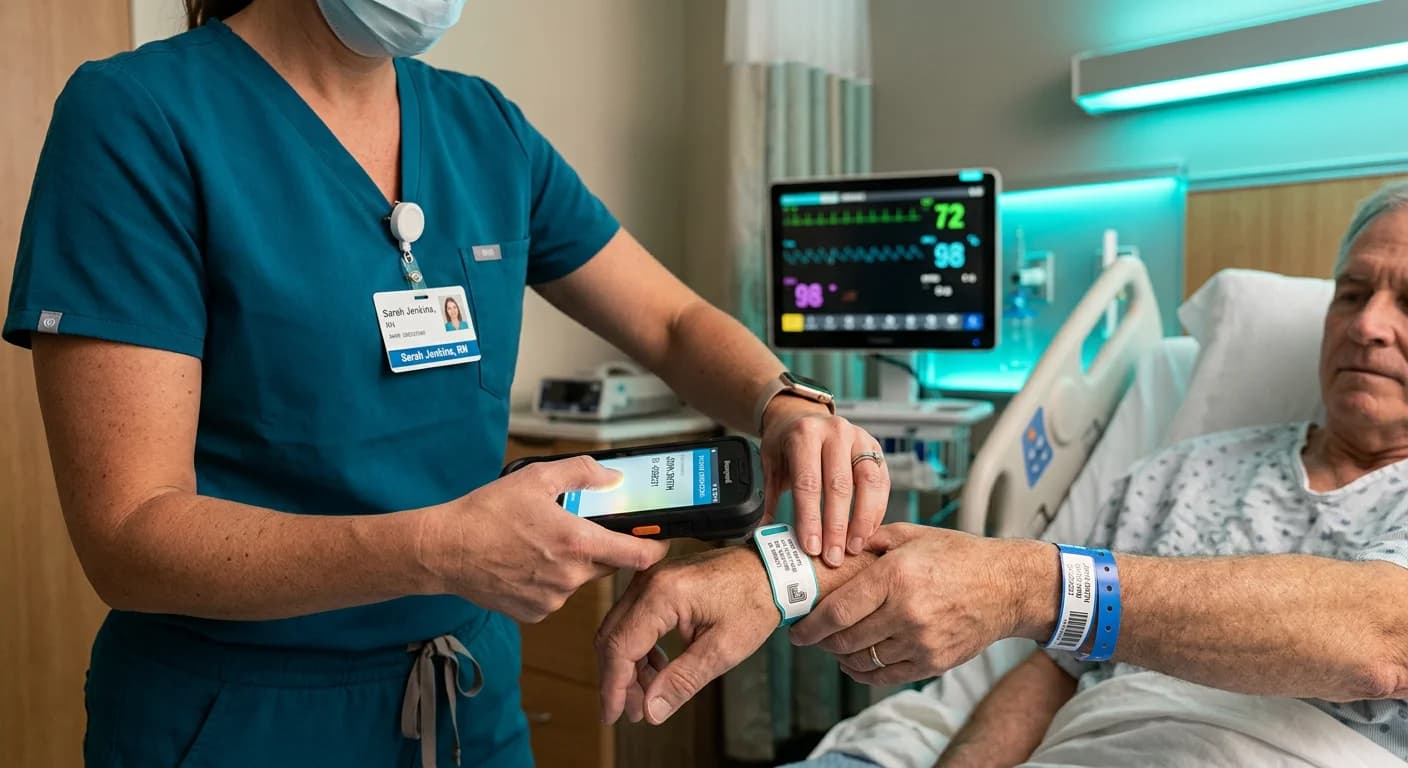
**RFID:** No line of sight required. A reader detects tags through packaging, bedding, clothing, and even walls. A nurse walking into a patient room with an RFID reader automatically identifies the patient, the infusion pump, and the medication — without scanning a single barcode.
**Healthcare impact:** In high-acuity environments like the ICU or operating room, the ability to identify patients and assets without manual scanning reduces workflow interruptions and improves compliance with safety protocols.
Read Speed and Volume
**Barcode:** One item at a time. Each barcode must be individually scanned. A full inventory count of a supply room with 500 items takes a technician 2-3 hours of manual scanning.
**RFID:** 100+ items simultaneously. An RFID reader can capture hundreds of tags in seconds. The same 500-item inventory count takes under 5 minutes with a handheld RFID reader — a 96% reduction in time.
**Healthcare impact:** Surgical instrument counts, medication inventory, and equipment audits that previously consumed hours of clinical and support staff time can now be completed in minutes. Operating room turnover times improve by 15-20% when RFID instrument counting replaces manual counts.
Data Capacity and Rewritability
**Barcode:** A standard 1D barcode holds 20-25 characters. A 2D barcode (QR code) can hold up to 4,296 characters. Once printed, the data is fixed — it cannot be updated without printing a new label.
**RFID:** An RFID tag can store 2 KB to 64 KB of data, depending on the tag type. Critically, RFID tags can be rewritten thousands of times. A surgical instrument tag can be updated after each sterilization cycle with the date, method, and operator — building a complete maintenance history on the tag itself.
**Healthcare impact:** Rewritable RFID tags enable dynamic data storage that evolves with the asset's lifecycle. Sterilization histories, calibration records, and maintenance logs can travel with the equipment, eliminating dependence on centralized databases for point-of-care decisions.
Durability and Environmental Resistance
**Barcode:** Printed barcodes degrade when exposed to moisture, chemicals, heat, abrasion, and UV light — all common in hospital environments. A wristband barcode that gets wet during bathing or a medication label that passes through steam sterilization may become unreadable.
**RFID:** RFID tags designed for healthcare withstand autoclave sterilization (134 degrees Celsius), chemical disinfection, refrigeration (down to -80 degrees Celsius for blood bank applications), and repeated mechanical handling. Encapsulated tags on surgical instruments survive thousands of sterilization cycles.
**Healthcare impact:** In environments where reliability is safety-critical — sterile processing, blood banks, operating rooms — RFID's durability advantage is decisive.
Cost Comparison
**Barcode labels:** $0.01-$0.05 per label. Barcode scanners cost $200-$800 each. Infrastructure costs are minimal since barcodes use existing printed materials and optical scanners.
**Passive RFID tags:** $0.10-$0.50 for standard tags, $2-$15 for specialized healthcare tags (autoclavable, wristband-integrated). RFID readers cost $500-$3,000 each. Fixed reader infrastructure (portals, ceiling mounts, antennas) adds $1,000-$5,000 per zone.
**Active RFID tags:** $5-$50 per tag. Active tags are used for high-value asset tracking where real-time location precision is essential (infusion pumps, ventilators, portable imaging). Infrastructure costs are higher due to the need for receiver arrays throughout the facility.
**Total cost of ownership:** While RFID has a higher upfront cost, the total cost of ownership over a 5-year period often favors RFID when labor savings, error reduction, and asset utilization improvements are factored in. A typical 300-bed hospital spends $200,000-$500,000 on initial RFID deployment and recovers the investment within 12-18 months.
Security and Data Protection
**Barcode:** Barcodes are optically readable by any scanner. There is no built-in encryption or access control. Any barcode scanner — including a smartphone camera — can read a patient wristband barcode, raising privacy concerns in open environments.
**RFID:** RFID tags support encryption, password protection, and access control. Only authorized readers with correct credentials can access tag data. This is essential for HIPAA compliance when tags store or reference Protected Health Information.
**Healthcare impact:** As patient data privacy regulations tighten globally, RFID's built-in security capabilities provide a significant compliance advantage over open barcode systems.
Use-Case Mapping: When to Use Which
Best Suited for Barcodes
Best Suited for RFID
Best Suited for a Hybrid Approach
Most leading hospitals use both technologies strategically:
Real Hospital Experiences
Large Academic Medical Center — Full RFID Deployment
A 900-bed academic medical center deployed RFID across patient identification, asset tracking, and surgical services. Results after 18 months:
Community Hospital — Hybrid Barcode-RFID Approach
A 200-bed community hospital with limited capital adopted a phased hybrid approach. Phase 1 deployed RFID for asset tracking of infusion pumps and wheelchairs (the two most frequently lost items). Phase 2 added RFID patient wristbands while retaining barcode scanning for medication verification.
Results after 12 months:
Making the Decision
The choice between RFID and barcode is not binary. The question is not which technology to use, but where each technology delivers the greatest return.
Start with the applications where RFID's advantages are most pronounced: asset tracking, patient identification, and surgical instrument management. These use cases deliver the fastest ROI and build organizational experience with the technology.
Retain barcodes where they work well: low-cost consumables, external interfaces, and legacy system integrations. Over time, as RFID costs continue to decline and infrastructure matures, the balance naturally shifts toward RFID for an expanding set of applications.
The healthcare organizations that thrive in this transition are those that view RFID not as a replacement for barcodes, but as an evolution of their identification infrastructure — one that delivers safety, efficiency, and intelligence that barcodes were never designed to provide.
Ready to Implement RFID in Your Facility?
Contact us to learn how our RFID solutions can improve patient safety and operational efficiency.
Related Articles
AI-Powered RFID Patient Tracking: The Future of Hospital Safety in 2026
Discover how artificial intelligence combined with RFID technology is revolutionizing patient safety, reducing falls, and preventing wandering incidents in healthcare facilities.
NFC Patient Wristbands: The Future of Bedside Verification
How NFC-enabled wristbands are transforming bedside verification in hospitals, offering tap-to-verify workflows that work through gloves and moisture while integrating seamlessly with smartphones and EHR systems.